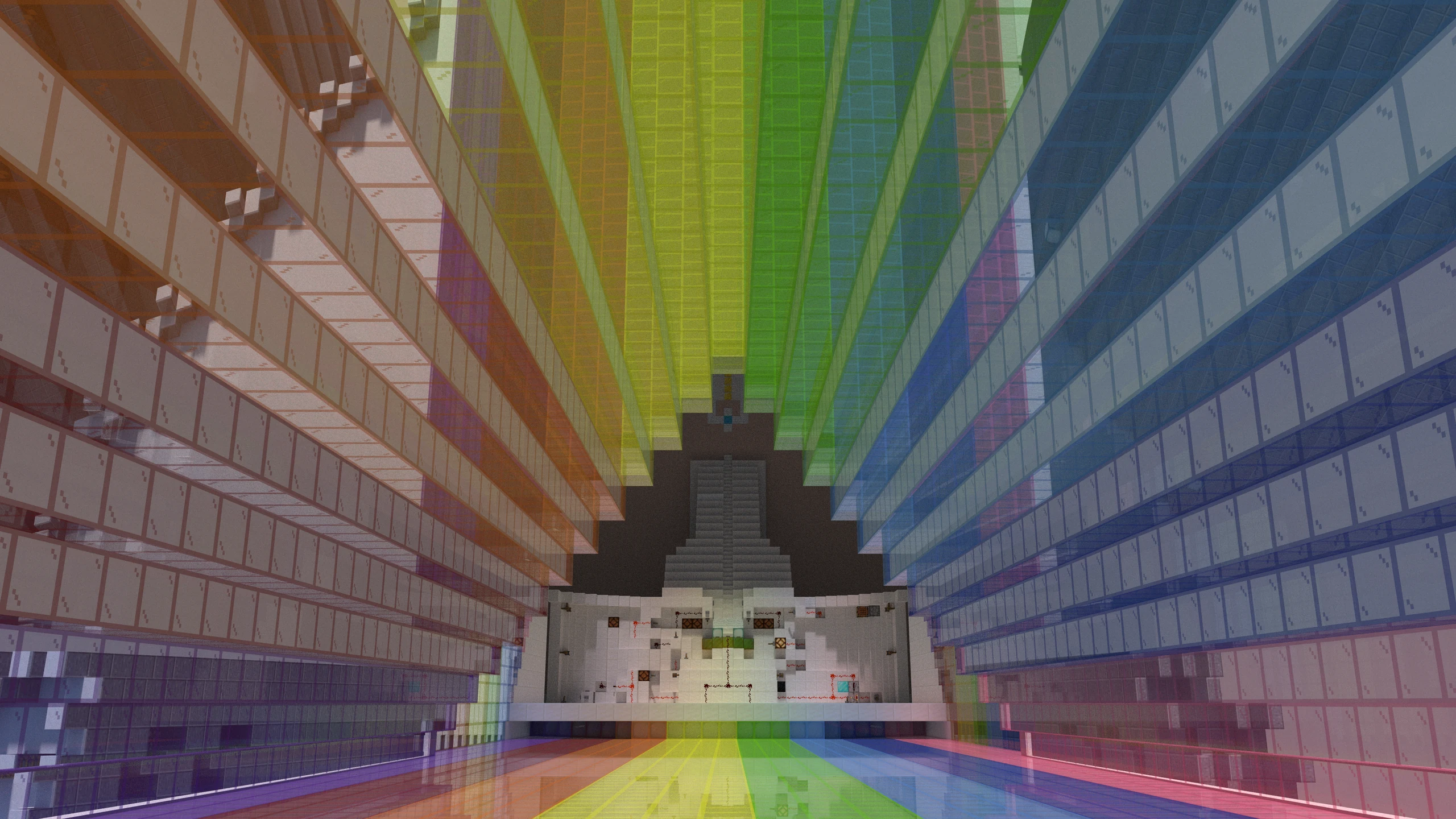
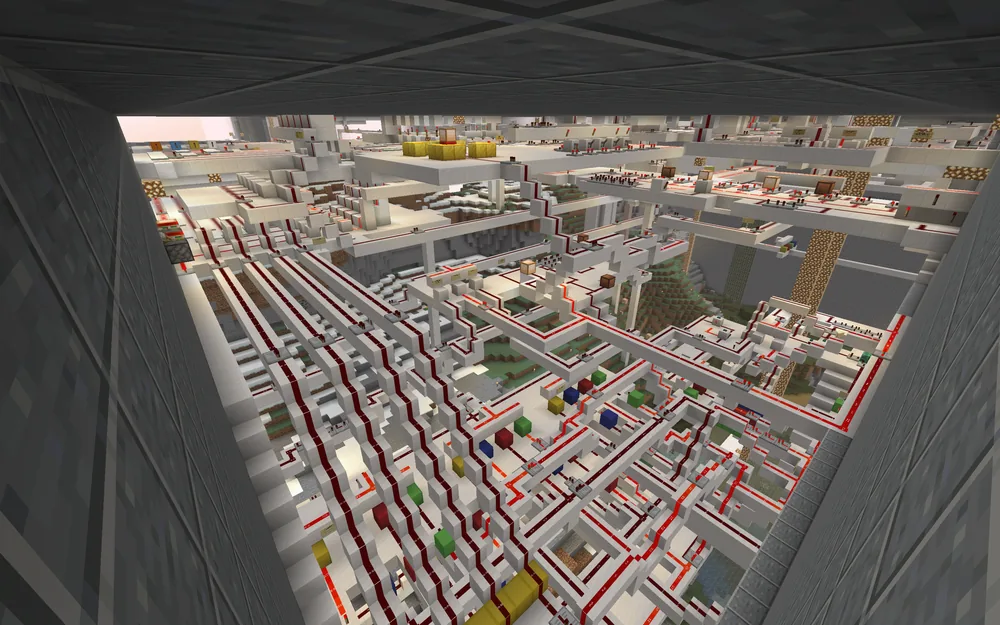
In 2017 the operator started building a computer inside Minecraft. Not a model of one — a working one, made of redstone: logic gates, an arithmetic unit, four-bit value-catching circuitry. He worked on it, on and off, for seven years, finishing the last component in July 2024. He called it Loop 1.0.
The name is not decoration. Its memory is built after the mercury delay line — a 1940s storage technology where data exists as acoustic pulses circulating through a tube of mercury, bits held in a loop, alive only in motion. Loop 1.0 rebuilds that idea in voxels: the bits do not sit in cells waiting to be read, they travel a loop line, kept alive by their own circulation. Everything downstream — Loop 2.1, then Loop MMT — carries that word because it started here.
It is a genuine computer in an unlikely medium, and it earned its own difficulty. Redstone is slow. At the scale the architecture wanted, one hertz was not going to be fun, and the machine had outgrown the game it was built in. That collision is the hinge: the next version, Loop 2.1, left Minecraft for the browser — and the pattern behind both of them became the methodology.
This page will grow. Most of its screenshots are still to come; for now it holds what it has, and the gallery is built to take the rest as they land.