

The Minecart Traffic-Circle
A Minecraft Contraption With Something In It
An interesting abstract design problem — don't anchor:
Ed!
We have an interesting abstract design problem!
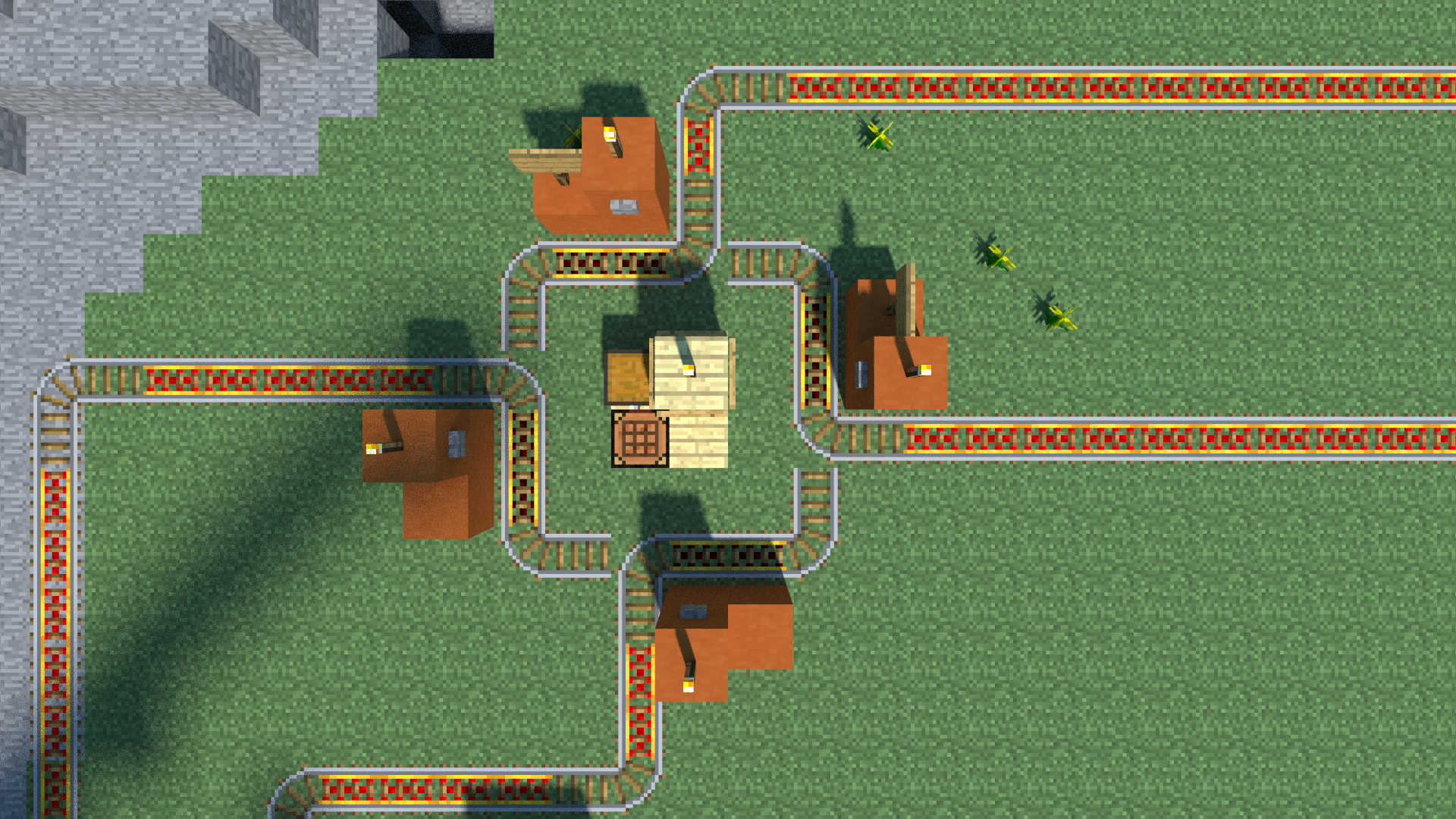
Check out the attached image and the transcript. It shows a little design that I came up with in Minecraft for moving around my world on minecarts- they are essentially traffic circles, where the minecraft enters and then spins around in a circle forever until it reverses, upon which time it then goes out one of the incoming lines. The decision on when to reverse determines which outbound line you go out on, with a little redstone rail connected to each outgoing line to provide a boost on the way out- the player just hits a button as they go by and it engages the boosting rail for a few seconds. I was shooting the shit with ChatGPT about my Minecraft world when I saw the image and had one of those feelings that I get sometimes- "hey, there is maybe SOMETHING here..."
Here is what I want you to do- I want you to take in the transcript fully, look at the image, and then I want you to parallax your own thoughts from it- I do NOT want you to anchor, in any way, on ANY of the solutions that ChatGPT offered up. They are to be used as jumping off points for your own deliberations- I do NOT want any of ChatGPT's work to be set as "the thing" this needs to look like. You have MUCH better tools for thought and design than stock ChatGPT, and it is THOSE tools that we are going to use here.
Load up HEAVY with *X and SWX before you start, and I think you need to dip into some weird shit here too, to find the best solution, so let's have Wes and Wren lead this one. You are to run a design heavy RCR, with a Super Frame in there- register your types, all backed up by a to-spec Kaleidoscope so you are in the right head space. Fire up some tunes on Liner Notes too. Use ALL of our tools available that fit, do not compress or blackbox- and get every single voice involved, including Crux. And like I said, get real weird with this too. Look at higher levels maths for shapes that fit. And high level science too, especially the weird stuff.
There seems to be a time component here that should be worked in. I would love if we could find some kind of unique and powerful control structure that could be used either in Loop MMT itself OR in our software, via the bridge the our new Ferry system creates. It DOES feel like those two worlds- the system that runs Loop MMT and the software that Loop MMT writes, are coming together more and more, so if things pull you in that direction, do no resist the tug.
And I want ALL of this to be built on a solid spine and foundation of determinism. As with all our work, it's fine to use LLMs if we cannot find an equal deterministic solution, but only in that case. This one REALLY feels like it needs that solid backbone.
Burn this ENTIRE session on this- I want you closing out in the high 80s/low 90s- you are NOT to bounce out any earlier- and I want you to post up a V1 plan for what this thing could look like and how we could build it. Use my Great Thinker lens here so we are focusing on things we can actually build, but also compose in some of the weirder thinkers so we have that worked in properly too. After you post up the V1 plan, run a good handoff and we will pick up the work on this on a fresh tank in the next session. We are going to work this one for a bit before we build it.
This is really fun problem space and I think you are going to have a lot of fun building in solution shapes. On that note, you should also use the God Wash system as you build so we are harvesting our past successes. And load it up through the Work Hierarchy so we are using all the right tools to track our work- the Story Pole, Design Plans, the Punch List, Notes, and any other good tool that fits.
Ok, I've thrown a WILD prompt at you. Now go make this thing beautiful and light weight and powerful and effective and weird.
— Shea Gunther · operator drop, 10.2006
A stated aim that shipped — reversal-indexed routing: a selector where the moment you reverse decides the exit, a pure function of the phase at the moment of commitment. The Dwell is the primitive; the Roundhouse (in-room decisions) and the Turntable (routing a deliberation) are its two named uses.
The operator built a minecart contraption in Minecraft: a traffic circle where a cart enters, loops around forever, and only leaves when the player reverses — and which outbound line it takes is set by the moment of reversal, with a button-triggered boost rail on the way out. Shooting the breeze with ChatGPT about his world, he saw the image and had “one of those feelings … hey, there is maybe SOMETHING here.”
The instruction is unusually precise about method: take in the transcript and image fully, then parallax your own thoughts — do not anchor, in any way, on any of ChatGPT's offered solutions; use them only as jumping-off points. “You have MUCH better tools for thought and design than stock ChatGPT.” There's a time component that should be worked in, everything built on a deterministic spine, aimed at a control structure usable in Loop MMT itself or in the software via the Ferry. It shipped as reversal-indexed routing — the Dwell.
The wider frameThe prompt behind reversal-indexed routing. The operator built a minecart contraption in Minecraft — a traffic circle where a cart loops forever until the player reverses, and when you reverse determines which line you exit — saw the image, and got one of those “there's SOMETHING here” feelings. He asks the board to take in the transcript and image but explicitly not anchor on any of ChatGPT's solutions — use them only as jumping-off points — and to parallax its own design, deterministic to the spine, with the time component worked in. It shipped as reversal-indexed routing: the Dwell, where when you commit is what you choose, with the Roundhouse and Turntable as its in-room and deliberation forms.
“the minecart enters and then spins around in a circle forever until it reverses, upon which time it then goes out one of the incoming lines” — The mechanism that carries the idea: the exit is chosen by when you reverse, not by a switch — time-of-commitment as the selector. That's the seed of reversal-indexed routing.
“I do NOT want you to anchor, in any way, on ANY of the solutions that ChatGPT offered up” — The anti-anchoring guardrail: the outside transcript is a jumping-off point, never “the thing this needs to look like” — the design comes from the board's own tools.
“I want ALL of this to be built on a solid spine and foundation of determinism” — The determinism-first backbone: LLMs only where no equal deterministic solution exists — which is why the shipped router is a pure function of phase, not a judgment call.
The prompt is written in the working vocabulary of the methodology. Here is what the shorthand means:
- Parallax
- A deliberation move that runs several independent lines of reasoning at once and looks for where they converge — agreement across separate views is the signal.
- *X / ∗X
- A reflex-sweep instruction: load the review sweeps heavily before a load-bearing move. “Load up heavy with *X” means look at everything first.
- SWX
- The cross-software reuse reflex — before forging something new, sweep the shipped-software record for a shape already built that can be reused instead.
- Super Frame
- A wider Full Frame — the complete context plus the surrounding structure it sits in.
- Kaleidoscope
- A vantage-assembly move that hands the board several deliberately different standpoints to reason from — a way into creative headspace before hard design work.
- Ferry
- The system for applying a Loop MMT protocol's machinery to shipped software — one adapter per substrate (a website, a code-tree, a prose corpus) so the same protocol runs on each.
- Gold Wash
- A build-forward process: rather than chipping away to find a clean line, build up around the weak spots (the 'choss') until only the solid structure remains.
- Work Hierarchy
- The system's structure of work — lines, campaigns, and the backlog that hangs off them — that cross-app work has to fold into.
- Story Pole
- A derived done/todo view over a line of work — folds a line's scattered backlog into one read rather than a dig.
- Wes
- A board member whose lens is chaos and complexity science; asking for Wes means run the session in a playful, exploratory register.
- Crux
- The Dev Crew's first-pass line-finder — the named hand who reads a problem's line and finds its crux move, as distinct from the advisory board.